

In late 1929, in Munich, C.G. Jung and the German sinologist Richard Wilhelm published a groundbreaking text: The Secret of the Golden Flower, an ancient Chinese Taoist treatise on inner alchemy.
Wilhelm’s sensitive translation opened a window into a deeply symbolic world, and Jung’s “European commentary” offered a Western psychological response to this Eastern wisdom. At first, Jung confessed he was bewildered by the text’s strangeness. But guided by Wilhelm’s lived understanding of Chinese culture and Taoist experience, he came to see it as a profound parallel to the Western path of individuation.
What Jung recognized was not a literal equivalence, but a deep resonance: both traditions speak to the necessity of a living relationship between the conscious personality and the greater unconscious – between the ego and the Self.
Jung wrote that the Chinese had achieved something the modern West had nearly forgotten:
A balanced consciousness.
A mode of being that does not cling to willpower alone, but lives with paradox.
Lives with cycles, not linear control.
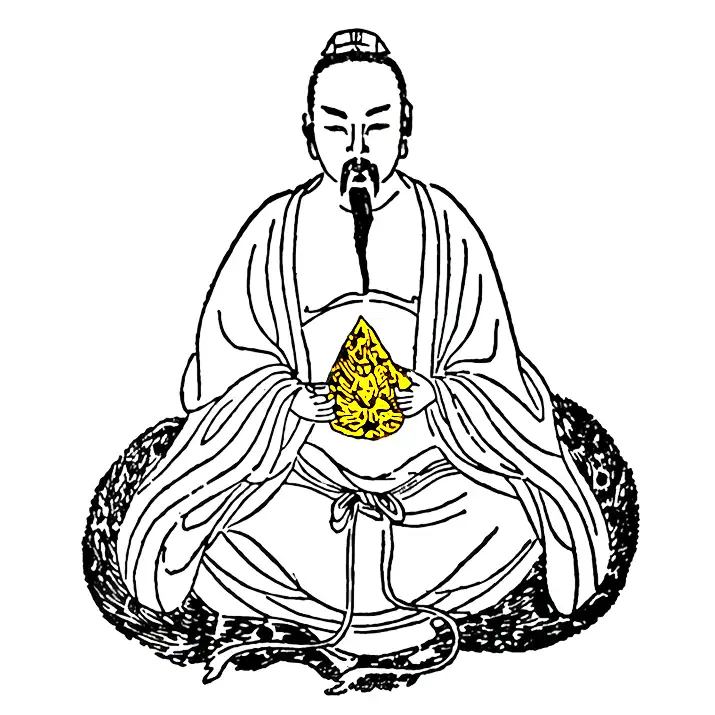
At the heart of The Secret of the Golden Flower lies a sacred principle:
Inner stillness allows the Light of the Self to circulate.
This is no passive state – it is an act of delicate, sustained attention to the subtle movements of the psyche.
A rotation of light within.
A return to the center.
A practice not of control, but of alignment with Tao. With the unconscious.
For Jung, this ancient alchemy mirrored the work he had been discovering in his own soul and with his patients:
The tension between opposites.
The slow, circular rhythm of deep change.
The need for a growing integration between consciousness and the unconscious.
Jung understood this text as universal – a voice from another culture affirming what the soul knows across time and place:
The Self is real.
It seeks to guide us.
It speaks in silence and symbol, not in commands.
And it must be approached with reverence.
Jung’s insight was not about appropriating Eastern practice but uncovering its psychological core: the integration of life and light, vitality and vision, body and spirit – toward the realization of the immortal inner Self.

To walk the Tao is not to tame the dragon, but to ride it.
“It is characteristic of the Western mind that it has no concept for Tao. The Chinese character is made up of the character for ‘head’ and that for ‘going.’ Wilhelm translates Tao by Sinn (Meaning). Others translate it as ‘way’, ‘providence’, or even as ‘God’, as the Jesuits do. This shows the difficulty. ‘Head’ can be taken as consciousness, and ‘to go’ as traveling a way; thus the idea would be: to go consciously, or the conscious way. This agrees with the fact that ‘the light of heaven’, which ‘dwells between the eyes’ as the ‘heart of heaven’, is used synonymously with Tao. Human nature and life are contained in ‘the light of heaven’ and, according to Liu Hua-yang, are the most important secrets of the Tao. Now ‘light’ is the symbolical equivalent of consciousness, and the nature of consciousness is expressed by analogies with light.
The Hui Ming Ching is introduced with the verse:
If thou wouldst complete the diamond body with no outflowing,
Diligently heat the roots of consciousness and life.
Kindle light in the blessed country ever close at hand,
And there hidden, let thy true self always dwell.
These verses contain a sort of alchemistic instruction, a method or way of creating the ‘diamond body’ which is also meant in our text. Heating is necessary; that is, there must be an intensification of consciousness in order that the dwelling place of the spirit may be illumined. But not only consciousness—life itself must be intensified. The union of these two produces ‘conscious life’. According to the Hui Ming Ching, the ancient sages knew how to bridge the gap between consciousness and life because they cultivated both. In this way the shen, the immortal body, is ‘melted out’, and in this way ‘the great Tao is completed’. If we take the Tao to be the method or conscious way by which to unite what is separated, we have probably come close to the psychological content of the concept. In any case, the separation of consciousness from life cannot very well be understood to mean anything but what I have described above as an aberration, or deracination, of consciousness. Without doubt, also, the realization of the opposite hidden in the unconscious, i.e., the ‘reversal’, signifies reunion with the unconscious laws of being, and the purpose of this reunion is the attainment of conscious life, or, expressed in Chinese terms, the bringing about of the Tao.”
~ C.G. Jung, Commentary to The Secret of the Golden Flower
In this dense and beautiful passage, Jung reflects on how the ancient Chinese character for Tao – formed by the signs for “head” and “to go” – can be understood as the conscious way:
a path walked not unconsciously or instinctively, but with presence and awareness.
Not blindly reacting, not floating through life – but going consciously.
This conscious path is symbolized by light – the primal image for consciousness itself.
Just as the “light of heaven” in Taoist texts is said to dwell “between the eyes”,
Jung sees in this a mirror to our own psychic center: the luminous Self.
But he emphasizes something subtle and profound: it is not consciousness alone that transforms us. We must also vitalize life itself. That means animating our instincts, our emotions, our breath, our embodiment. Only when consciousness and life are both “heated” – intensified through attention, discipline, and spiritual maturity – does something new emerge.

and the elegance of walking the Way without force
This union gives birth to what the Taoists called the diamond body – a symbol for the enduring Self, forged through inner alchemy.
We suffer when our consciousness is cut off from life, when we live in our heads, ideas, or spiritual ideals while neglecting the blood and breath of being.
Jung calls this deracination – a losing of our roots.
But the reversal – turning back toward the unconscious, toward the forgotten laws of being – allows us to heal that split. To bring forth a more integrated life and personality.
This, Jung says, is the true Tao – not a dogma or a belief, but a way of being that unites the divided parts of the soul.
This is the way.
Leave a Reply