

“The years, of which I have spoken to you, when I pursued the inner images, were the most important time of my life. Everything else is to be derived from this. It began at that time, and the later details hardly matter anymore. My entire life consisted in elaborating what had burst forth from the unconscious and flooded me like an enigmatic stream and threatened to break me. That was the stuff and material for more than only one life. Everything later was merely the outer classification, the scientific elaboration, and the integration into life. But the numinous beginning, which contained everything, was then.”
~C.G. Jung, 1957 interview with Aniela Jaffé (The Red Book, author’s note)
What if the most important work we’ll ever do cannot be seen from the outside?
In 1957, nearing the end of his life, Jung didn’t point to his books, travels, or public achievements as the centerpiece of his legacy. Instead, he turned inward, back to a private time between 1913–1917, after his break with Freud, when he plunged into his central confrontation with the unconscious. The visions, voices, and inner figures that emerged became the heart of his Red Book, a document he never published in his lifetime, but always referred to as the foundation of all his later work.

“To the superficial observer, it will appear like madness. It would also have been madness, had I not been able to absorb the overpowering force of the original experiences.”
Jung didn’t choose this path. It broke open inside him. He wrote that the unconscious flooded him like an enigmatic stream and threatened to break him. These are not the words of someone indulging in fantasy, but of someone who is being initiated.
Everything else, he said – his books, theories, career – was simply “outer classification.” The true work had already happened. In secret. In dialogue with the depths.
Jung didn’t just write down what he encountered, but painted it. Page after page, he illuminated his visions with intricate, symbolic images rendered in great detail, as acts of reverence. He sensed that the unconscious deserved not only attention, and interpretation, but response. In painting these figures, mandalas, and scenes, Jung entered into a deep dialogue with the inner world. The Red Book became his sacred vessel, as part of his alchemical work of transformation.
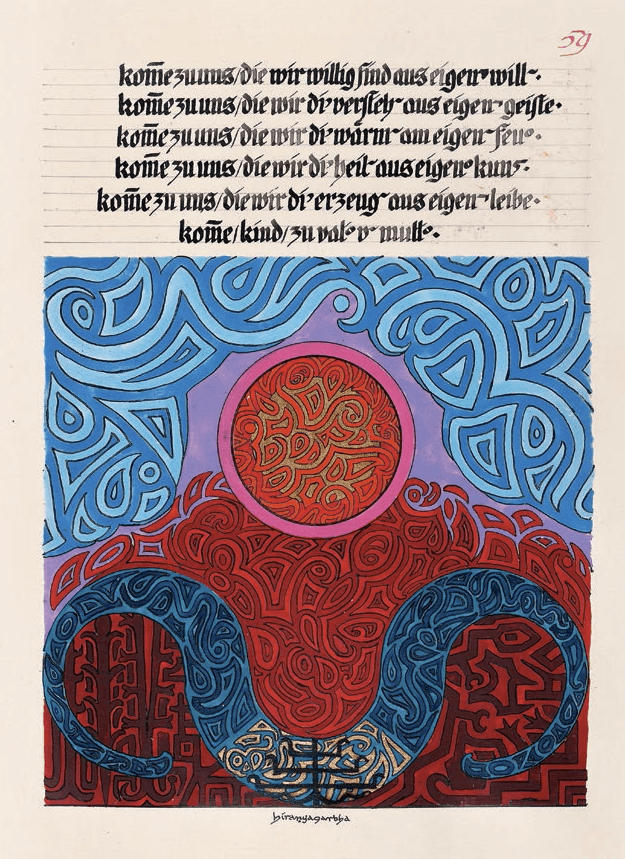
There is something profoundly humbling in this. To realize that Jung, this giant of modern and future psychology, did not see himself as a builder of systems, but as a servant of the images that arose from the depths. His work was never meant to explain away the psyche, but to enter into relationship with it, as an autonomous and mysterious entity.
Perhaps this is what individuation truly demands of us: that we become willing to listen to what the unconscious is trying to say – not to label it, but to let it change us, while we contain the uncertainty, solitude and pain that this process demands. It may not feel glorious and heroic when we’re in it, but it is a sacred initiation into the mystery of our own being.
Not every storm is meant to be avoided. Some are meant to be endured – because they carry us home, they reveal to us who we might become.

What arises from your depths may not look rational. It may not make sense to those around you, and to yourself until it does. It could be the most important thing you ever do.
“I am deeply convinced, that those ideas that came to me, are really quite wonderful things. I can easily say that (without blushing), because I know, how resistant and how foolishly obstinate I was, when they first visited me and what a trouble it was, until I could read this symbolic language, so much superior to my dull conscious mind.”
~Jung in a letter to Henry Murray
Leave a Reply