I’ve been sitting with several extraordinary passages from Jung’s book The Development of Personality, and I keep returning to these piercing lines:
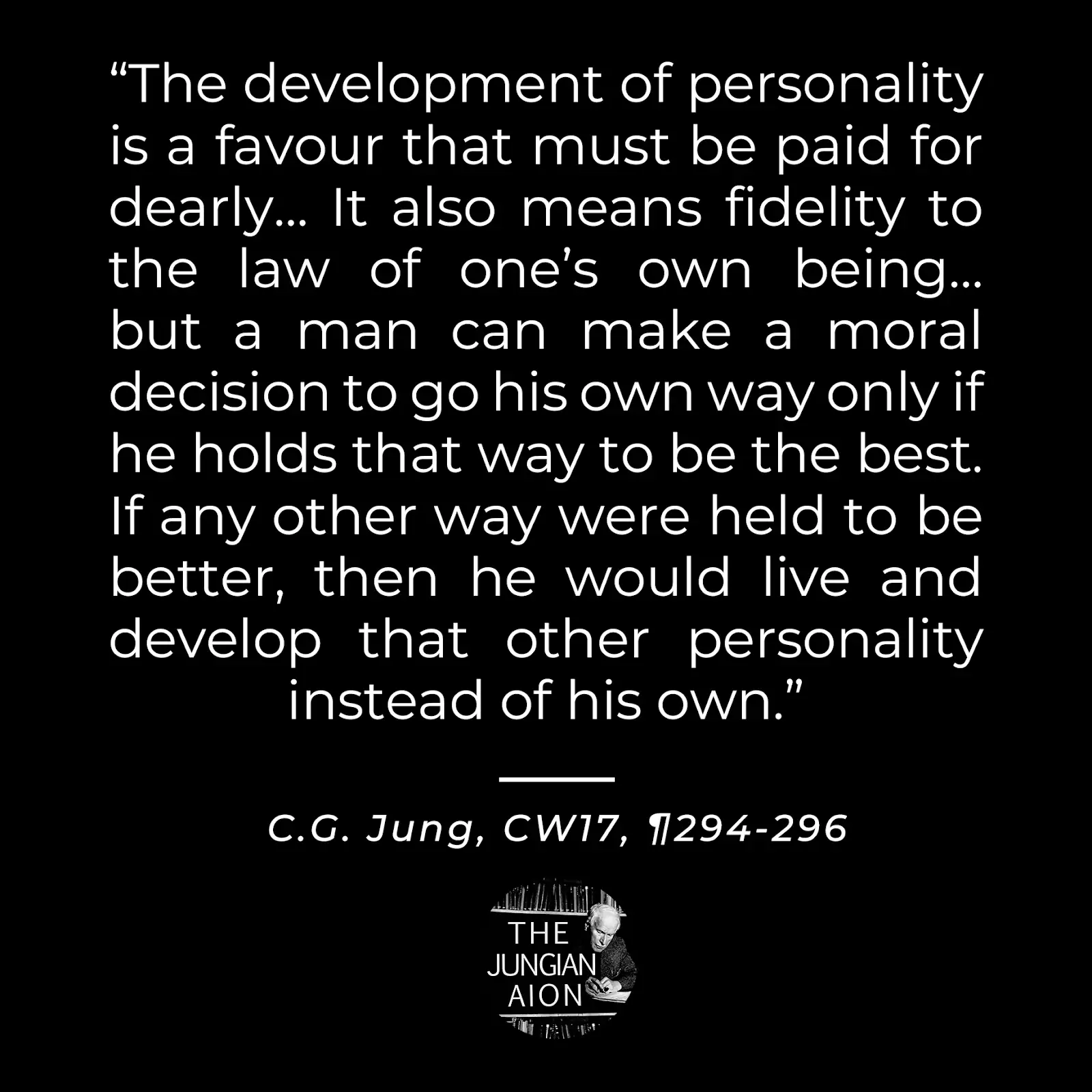
“The developing personality obeys no caprice… only brute necessity; it needs the motivating force of inner or outer fatalities… the words “many are called, but few are chosen” are singularly appropriate here… this means isolation, and there is no more comforting word for it… The development of personality is a favour that must be paid for dearly… It also means fidelity to the law of one’s own being… but a man can make a moral decision to go his own way only if he holds that way to be the best. If any other way were held to be better, then he would live and develop that other personality instead of his own… renouncing one’s wholeness and running away from the final consequences of one’s own being.” (I’ll include a selection of relevant paragraphs in the end of this reflection.)
What strikes me most about Jung’s reflection isn’t just the truth of the solitude that comes with choosing one’s own way and personality, it’s Jung’s deep affirmation of what that path costs, and why so few are willing to walk it.
Reading these words felt like reading a map of my own journey.
There have been many points in my life where I’ve felt that pull, a quiet but persistent “daemon” as Jung calls it, a guiding spirit. A sense of a deeper law within that I must remain faithful to, even when other inner and outer voices urged me elsewhere. And each time I truly listen and follow it, there’s a kind of shedding: of roles, identities, sometimes even people.
Jung doesn’t sugarcoat it – he never does. He reminds us: you don’t become yourself by accident or convenience. It’s not a cosmetic project. It’s a fate and a calling. A vocation.
It doesn’t promise reward in the conventional sense. Not success, belonging, or certainty. What it offers is meaning.
It’s only by making the conscious, moral choice to go our own way – despite the loneliness, the doubt, and the misunderstanding – that we may become whole.
What parts of ourselves have we abandoned for the sake of convention?
Where have we traded truth for the comfort of belonging?
What part of us is ready to move from silence to embodiment?
You that are reading and feeling this – you’re not alone in this mysterious and frightening, dangerous and joyful path. The journey may be narrow, unpopular, and solitary – but it’s not without company. There have always been others.
If you feel the ache of not fitting in because you’re trying to be you – not a shinier version of what others expect – know that you are called.
And that call is worth answering.
~~~~
From Jung’s book The Development of Personality, excerpts from paragraphs 293–302 (with several omissions):
[293] …The only thing that moves nature is causal necessity, and that goes for human nature too. Without necessity nothing budges, the human personality least of all. It is tremendously conservative, not to say torpid. Only acute necessity is able to rouse it. The developing personality obeys no caprice, no command, no insight, only brute necessity; it needs the motivating force of inner or outer fatalities…
[294] The words “many are called, but few are chosen” are singularly appropriate here, for the development of personality from the germ-state to full consciousness is at once a charisma and a curse, because its first fruit is the conscious and unavoidable segregation of the single individual from the undifferentiated and unconscious herd. This means isolation, and there is no more comforting word for it. Neither family nor society nor position can save him from this fate, nor yet the most successful adaptation to his environment, however smoothly he fits in. The development of personality is a favour that must be paid for dearly…
[295] Yet the development of personality means more than just the fear of hatching forth monsters, or of isolation. It also means fidelity to the law of one’s own being.
[296] For the word “fidelity” I should prefer, in this context, the Greek word used in the New Testament, πίστις (pístis) which is erroneously translated “faith.” It really means “trust,” “trustful loyalty.” Fidelity to the law of one’s own being is a trust in this law, a loyal perseverance and confident hope; in short, an attitude such as a religious man should have towards God. It can now be seen how portentous is the dilemma that emerges from behind our problem: personality can never develop unless the individual chooses his own way, consciously and with moral deliberation. Not only the causal motive—necessity—but conscious moral decision must lend its strength to the process of building the personality. If the first is lacking, then the alleged development is a mere acrobatics of the will; if the second, it will get stuck in unconscious automatism. But a man can make a moral decision to go his own way only if he holds that way to be the best. If any other way were held to be better, then he would live and develop that other personality instead of his own. The other ways are conventionalities of a moral, social, political, philosophical, or religious nature. The fact that the conventions always flourish in one form or another only proves that the vast majority of mankind do not choose their own way, but convention, and consequently develop not themselves but a method and a collective mode of life at the cost of their own wholeness.
[297] Just as the psychic and social life of mankind at the primitive level is exclusively a group life with a high degree of unconsciousness among the individuals composing it, so the historical process of development that comes afterwards is in the main collective and will doubtless remain so. That is why I believe convention to be a collective necessity. It is a stopgap and not an ideal, either in the moral or in the religious sense, for submission to it always means renouncing one’s wholeness and running away from the final consequences of one’s own being.
[298] To develop one’s own personality is indeed an unpopular undertaking, a deviation that is highly uncongenial to the herd, an eccentricity smelling of the cenobite, as it seems to the outsider. Small wonder, then, that from earliest times only the chosen few have embarked upon this strange adventure. Had they all been fools, we could safely dismiss them as mentally “private” persons who have no claim on our interest. But, unfortunately, these personalities are as a rule the legendary heroes of mankind, the very ones who are looked up to, loved, and worshipped, the true sons of God whose names perish not. They are the flower and the fruit, the ever fertile seeds of the tree of humanity… Their greatness has never lain in their abject submission to convention, but, on the contrary, in their deliverance from convention. They towered up like mountain peaks above the mass that still clung to its collective fears, its beliefs, laws, and systems, and boldly chose their own way. To the man in the street it has always seemed miraculous that anyone should turn aside from the beaten track with its known destinations, and strike out on the steep and narrow path leading into the unknown. Hence it was always believed that such a man, if not actually crazy, was possessed by a daemon or a god; for the miracle of a man being able to act otherwise than as humanity has always acted could only be explained by the gift of daemonic power or divine spirit. How could anyone but a god counterbalance the dead weight of humanity in the mass, with its everlasting convention and habit? … for the ordinary man the outstanding personality is something supernatural, a phenomenon that can only be explained by the intervention of some daemonic factor.
[299] What is it, in the end, that induces a man to go his own way and to rise out of unconscious identity with the mass as out of a swathing mist? Not necessity, for necessity comes to many, and they all take refuge in convention. Not moral decision, for nine times out of ten we decide for convention likewise. What is it, then, that inexorably tips the scales in favour of the extra-ordinary?
[300] It is what is commonly called vocation: an irrational factor that destines a man to emancipate himself from the herd and from its well-worn paths. True personality is always a vocation and puts its trust in it as in God, despite its being, as the ordinary man would say, only a personal feeling. But vocation acts like a law of God from which there is no escape. The fact that many a man who goes his own way ends in ruin means nothing to one who has a vocation. He must obey his own law, as if it were a daemon whispering to him of new and wonderful paths. Anyone with a vocation hears the voice of the inner man: he is called. That is why the legends say that he possesses a private daemon who counsels him and whose mandates he must obey…
[301] The original meaning of “to have a vocation” is “to be addressed by a voice.” The clearest examples of this are to be found in the avowals of the Old Testament prophets. That it is not just a quaint old-fashioned way of speaking is proved by the confessions of historical personalities such as Goethe and Napoleon, to mention only two familiar examples, who made no secret of their feeling of vocation.
[302] Vocation, or the feeling of it, is not, however, the prerogative of great personalities; it is also appropriate to the small ones all the way down to the “midget” personalities, but as the size decreases the voice becomes more and more muffled and unconscious. It is as if the voice of the daemon within were moving further and further off, and spoke more rarely and more indistinctly. The smaller the personality, the dimmer and more unconscious it becomes, until finally it merges indistinguishably with the surrounding society, thus surrendering its own wholeness and dissolving into the wholeness of the group. In the place of the inner voice there is the voice of the group with its conventions, and vocation is replaced by collective necessities. But even in this unconscious social condition there are not a few who are called awake by the summons of the voice, whereupon they are at once set apart from the others, feeling themselves confronted with a problem about which the others know nothing. In most cases it is impossible to explain to the others what has happened, for any understanding is walled off by impenetrable prejudices. “You are no different from anybody else,” they will chorus, or, “there’s no such thing,” and even if there is such a thing, it is immediately branded as “morbid” and “most unseemly.” For it is “a monstrous presumption to suppose anything of that sort could be of the slightest significance”—it is “purely psychological.” This last objection is extremely popular nowadays. It stems from a curious underestimation of anything psychic, which people apparently regard as personal, arbitrary, and therefore completely futile. And this, paradoxically enough, despite their enthusiasm for psychology. The unconscious, after all, is “nothing but fantasy.” We “merely imagined” so and so, etc. People think themselves magicians who can conjure the psyche hither and thither and fashion it to suit their moods. They deny what strikes them as inconvenient, sublimate anything nasty, explain away their phobias, correct their faults, and feel in the end that they have arranged everything beautifully. In the meantime, they have forgotten the essential point, which is that only the tiniest fraction of the psyche is identical with the conscious mind and its box of magic tricks, while for much the greater part it is sheer unconscious fact, hard and immitigable as granite, immovable, inaccessible, yet ready at any time to come crashing down upon us at the behest of unseen powers. The gigantic catastrophes that threaten us today are not elemental happenings of a physical or biological order, but psychic events.”

Leave a Reply